
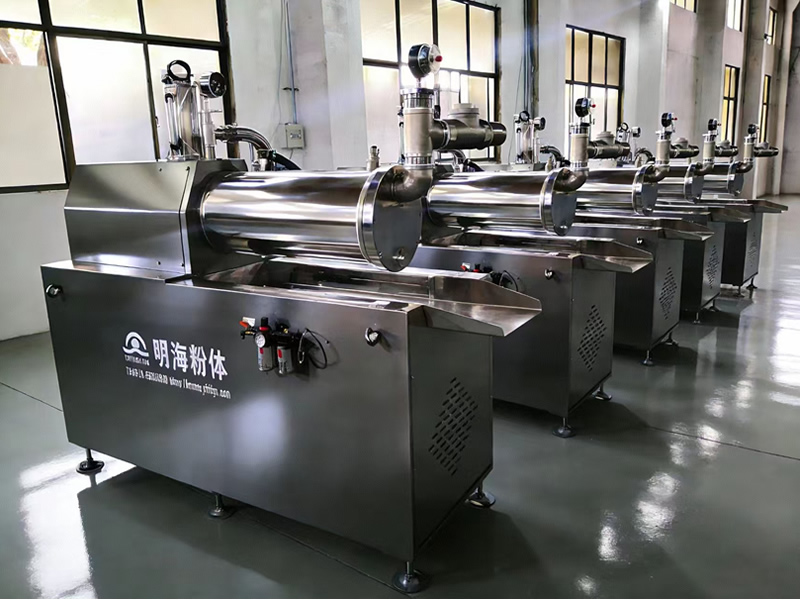
Summarize:
Horizontal sand mill is a highly efficient continuous wet ultrafine grinding and dispersion equipment. It achieves fine processing of solid-liquid phase materials through high-speed collision, friction and shearing between grinding media and materials. It is widely suitable for production scenarios with high viscosity and fine particle size requirements and is a core equipment in new energy and new materials fine chemical industries such as coatings, inks, pigments, lithium battery materials and nanomaterials.
Primary structure:
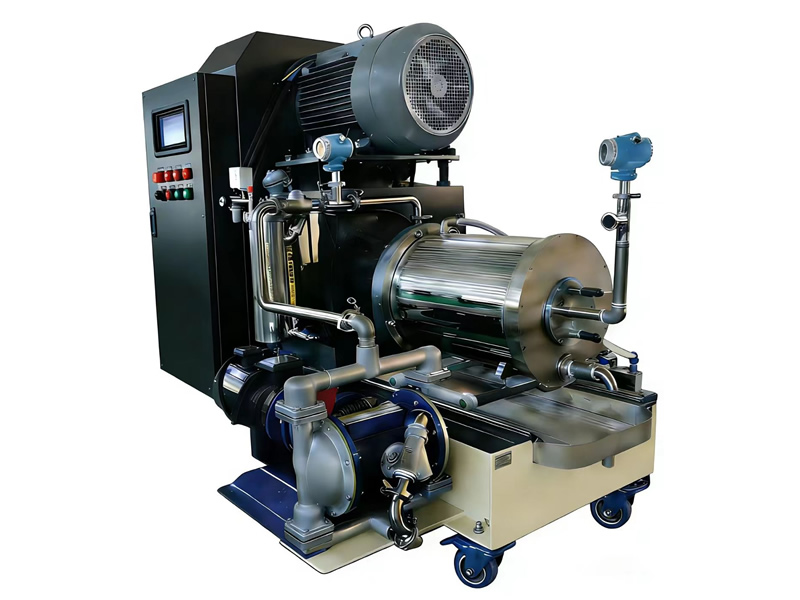
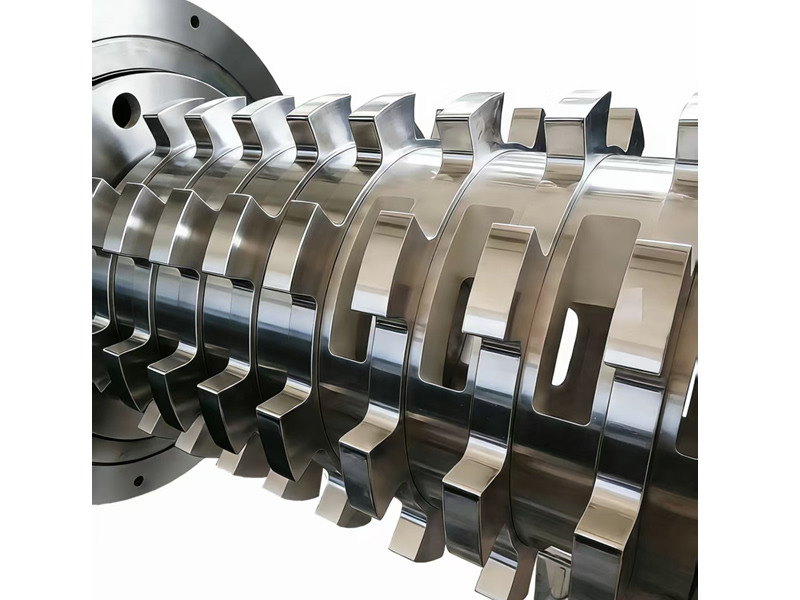
Main unit components: including grinding cylinder (carbon steel/stainless steel material), main shaft, dispersion disc/pin rotor (core grinding component), dynamic medium separator (for separating grinding media from finished products).
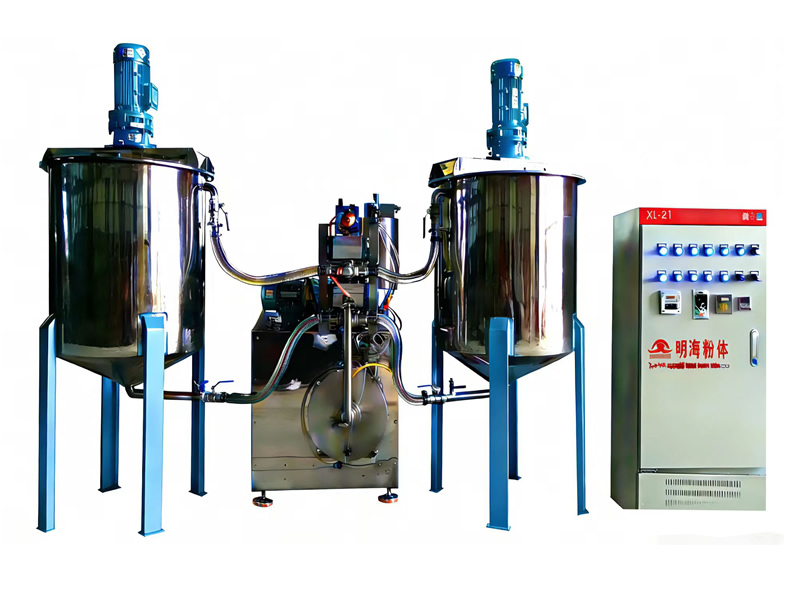
Auxiliary system: including cooling device (for controlling grinding temperature), feeding pump (gear pump/pneumatic diaphragm pump), double-end face mechanical seal (zero leakage protection), PLC control system (for monitoring temperature/pressure/speed).
Grinding medium: The mainstream uses zirconia beads (high hardness, wear-resistant, and easy to clean), with a particle size of 0.1 to 2 millimeters. The filling rate is preferably around 80%.
Operating principle:
The pre-treated solid-liquid phase materials are fed into the grinding cylinder by the feeding pump.
2. The main shaft drives the dispersion disc to rotate at high speed, endowing the grinding medium with kinetic energy. This intense collision and shearing effect occurs with the material, refining the particles and dispersing the aggregates.
3. The ground materials are separated by a dynamic separator and continuously discharged from the discharge pipe, with the entire process carried out in a closed manner.
4. Advantages: Closed continuous production, uniform product particle size (down to below 1 micron), and high production efficiency; Zero leakage design prevents material drying and skinning as well as solvent evaporation. No fixed installation foundation is required, and disassembly, assembly and maintenance are convenient.
5. Features: High energy conversion rate, narrow particle size distribution during nano-scale grinding; It is compatible with various materials and can meet different requirements by adjusting the rotational speed and medium parameters.
Technical specification:
| Model [L] | CXM-20 | CXM-30 | CXM-60 | CXM-90 | CXM-150 | CXM-250 | CXM-400 | |
|---|---|---|---|---|---|---|---|---|
| Effective volume of the grinding chamber [L] | 20 | 30 | 0 | 90 | 150 | 250 | 400 | |
| Main driving power [KW] | 30 | 37-45 | 75-90 | 90-110 | 185-200 | 250-280 | 450-500 | |
| Specifications of applicable grinding media [MM] | 0.3-1.2 | 0.3-1.2 | 0.3-1.4 | 0.3-1.4 | 0.3-1.6 | 0.3-1.6 | 0.3-1.6 | |
| Processing batch size [L] | 100-1000 | 200-2000 | 300-3000 | 500-3500 | 800-5500 | 1000-7500 | 3000-12000 | |
| Flow [KG/H] | 100-1500 | 300-2500 | 500-35000 | 700-4500 | 800-6000 | 10000-15000 | 5000-14000 | |
| Size [MM] | L | 1500 | 1800 | 2150 | 2465 | 2680 | 3400 | 5600 |
| K | 1050 | 1050 | 1300 | 1360 | 1370 | 1780 | 1750 | |
| H | 1700 | 1750 | 2200 | 2400 | 2460 | 2640 | 2950 | |
| Weight[KG] | 1400 | 1900 | 3000 | 5000 | 7000 | 8500 | 9000 | |

